

This painting is a remarkable example of the enduring tradition of Persian miniature painting in the modern era—an artwork that poetically and vividly reimagines Iran’s epic and mythological past through a precise and expressive visual language. While remaining faithful to classical forms, Zaviyeh infused the work with his own rhythm, palette, and composition, creating a piece that is both a reflection of history and a mirror of the Iranian aesthetic spirit.
Mohammadreza Ghaemmaghami
33 Content
-
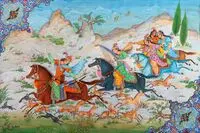 MohammadAli Zaviyeh in the Raha Gallery Collection
 -
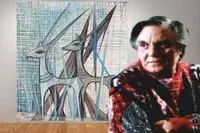 Jazeh Tabatabai and the Earthenware of Susa in the Raha Gallery Collection
The traces of goats on the painted ceramics of ancient Susa find their way into the gazelles of Persian poetry and Iranian miniature in this painting, which has endured for more than half a century. The fusion of the “mythical animal” with “geometric abstraction” embodies a quest for identity—one that remains distinctly Eastern and Iranian, yet resonates in dialogue with international modern art.
-
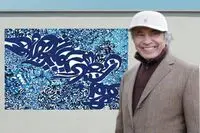 Hossein Zenderoudi in Raha Gallery Collection
The 53-year-old work Variation Tendre Tourmaline by Hossein Zenderoudi bears a French title meaning “Tender Tourmaline,” a poetic reference to a semi-precious stone. The name infuses the composition with a sense of preciousness and delicacy, enhancing the gem-like quality of its calligraphic lines. The painting is a visual–spiritual experience: letters swirl like particles of energy, inviting viewers to contemplate both meaning and form.
-
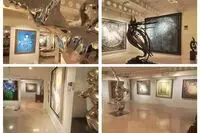 Raha Gallery Collection Through the Lens of Iran Art / Photos
The Raha Gallery Collection, founded and directed by engineer Mohammadreza Ghaemmaghami, has been actively engaged in promoting regional art for over two decades. With a sustained cultural mission focused on elevating the arts of the Middle East, the collection houses an exceptional selection of modernist and contemporary masterpieces by leading Iranian and Arab artists.
-
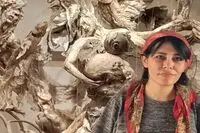 Elham Fallahi’s Ahura Mazda Sculpture in the Bundahishn Installation at Raha Gallery Collection
The sculpture Ahura Mazda, at the heart of Elham Fallahi’s monumental installation Bundahishn, is not merely one among its 82 sculptures but the conceptual, visual, and philosophical core of the work—the point where chaos and waste are transfigured into creation and meaning.
-
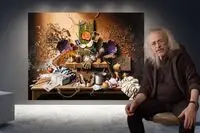 Wahed Khakdan in Raha Gallery Collection
This painting is among the most dramatic and yet hopeful works of Wahed Khakdan—an exquisitely melancholic and subtly humorous piece held in the Raha Middle East Gallery Collection. Khakdan, with his distinctive mastery, avoids depicting superficial joy; instead, he evokes a forgotten but resilient kind of happiness—one that lingers quietly within ordinary objects, faded memories, and muted colors. Embedded within the painting are layers of Iranian culture—carpets, traditional letters,…
-
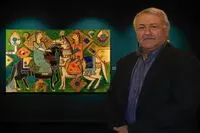 A Masterpiece by Sadegh Tabrizi in the Raha Gallery Middle East Collection
An authentic example of Saqqakhaneh painting: rich with religious, popular, and mystical symbols; a fusion of calligraphy and miniature painting; a blend of tradition, myth, and modern form. A visual poem. The horsemen—adorned with swords, flowing robes, and headdresses—appear as mythical figures, perhaps drawn from the Shahnameh or romantic epic tales. This series is known in the Iranian art community as “The Romantic Horsemen,” created around the 1970s and 80s.
-
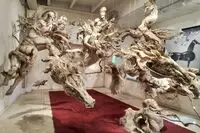 Bundahishn by Elham Fallahi in the Raha Gallery Collection
Bundahishn, an installation sculpture by Elham Fallahi, is a work about the philosophy of creation and mythical gods who are the protectors and guardians of nature. Suspended between earth and sky, the work occupies an impressive six by six by four meters in the private showroom of the Raha Gallery Collection.
-
 Farhad Moshiri In the Raha Gallery Collection
On July 17, 2024, Iranian artist Farhad Moshiri passed away at the age of 61. A groundbreaking figure in Middle Eastern contemporary art, Moshiri made history by setting two million-dollar records at international auctions. His unique engagement with pop art rendered his practice iconic in the region, to the extent that in 2017, the Andy Warhol Museum in the United States dedicated a solo exhibition to his work.
-
 Mehdi Vishkai in the Raha Gallery Collection
Mehdi Vishkai’s work invites us to pause—not just before the image, but within ourselves. This painting is not merely a representation of a face; it is a mirror reflecting psychological, social, and perhaps even historical conditions. Subdued greens suggest a life stilled, while deep blues echo the weight of a lingering sorrow.