

An Artistic Journey from Balkans to Far East
TEHRAN (Iranart) – Nose to Nose is the first exhibition by the ‘Slavs and Tatars’ art group in Iran. The group’s work is centered on three activities: exhibitions, books and lectures.
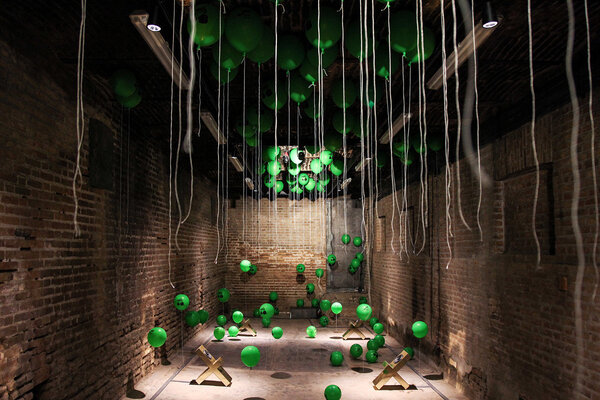
The exhibition of Slavs and Tatars art group is currently underway at Pejman Foundation: Argo Factory in Tehran.
Slavs and Tatars is an art collective, a faction of polemics and intimacies devoted to an area east of the former Berlin Wall and west of the Great Wall of China known as Eurasia. Marking the group’s tenth year anniversary, the exhibit, titled Nose to Nos’, features sculptures, audio works and publications.
Slavs and Tatars’ insistence on metaphysical and intellectual mix marks their unique place in contemporary art. The artists involved in the group have so far exhibited their works in major institutions across the globe.
here is a statue of Molla Nasreddin at the court of Argo Factory, which symbolizes a wise but down to earth Sufi. The reason for its presence there is because Slavs and Tatars are multinational communities with traces of artworks stretching from the Balkans to China. A red river runs through the exhibit which symbolizes violence and festivity all at the same time.
In the Milling Room there are decorative works entitled No Moscow, which narrates multiculturalism in Central Asia. It represents a temple with a table in the middle of the room decorated with imaginary fruits. The idea is to allow visitors to reflect and feel the atmosphere of the exhibit.
Also at the exhibit, a Persian translation of David Joselit’s ‘On Aggregators’ has been unveiled. The book was originally published in October. In the book, Joselit, a professor of art history at Yale University, poses an interesting and relevant argument on what the term contemporary means today.
Also at the exhibit, Dinjas, Donyas or Dinias represents the fruit name quince in the Serbian language. It is a common name for girls, representing beauty.
Also at the exhibit, Fragrant Concubine, meaning atomizing mistress, is a collection of light statues reminding the legend of Iparhan, a princess from West China who was kidnapped and then forced into marriage with Kialang. She asks for watermelon as it reminds her of her country or origin. She finally gets killed by the queen for refusing to sleep with her abductor.
Also at the exhibit, there is Filtering Hall, entitled Riverbed. Here, visitors can learn more about books and publications in Tatar and Slav languages. There are 8 books to be had.
Also at the exhibit, there is room number 2 Cooling Hall. There is an acoustic instrument called Lektor, which plays mystic stories in Turkish language. There are green balloons hanging from the ceiling or scattered on the floor. It seems they have been arranged there to complete the audio playing out of the Lektor.
For the past ten years, since its founding in 2006, Slavs and Tatars art group has held shows in many countries. The group artists work across cycles, where extended periods of research give life to an eco-system of installations, sculptures, lectures, and printed matter that question our understanding of language, ritual and identity. Imbued with humor and a generosity of spirit, their work commonly blends pop visuals with esoteric traditions, oral rituals with scholarly analysis in a way that opens new paths of contemporary discourse.
The Tehran exhibit is open to the public through July 14 at the foundation, a non-profit cultural institution located at No. 6, Behdasht St., Taghavi St., Ferdowsi Ave.