

Fardokht Kiaei Mehr and the Nature of the Contemporary Human in "Halo" Painting from the Takapo Series
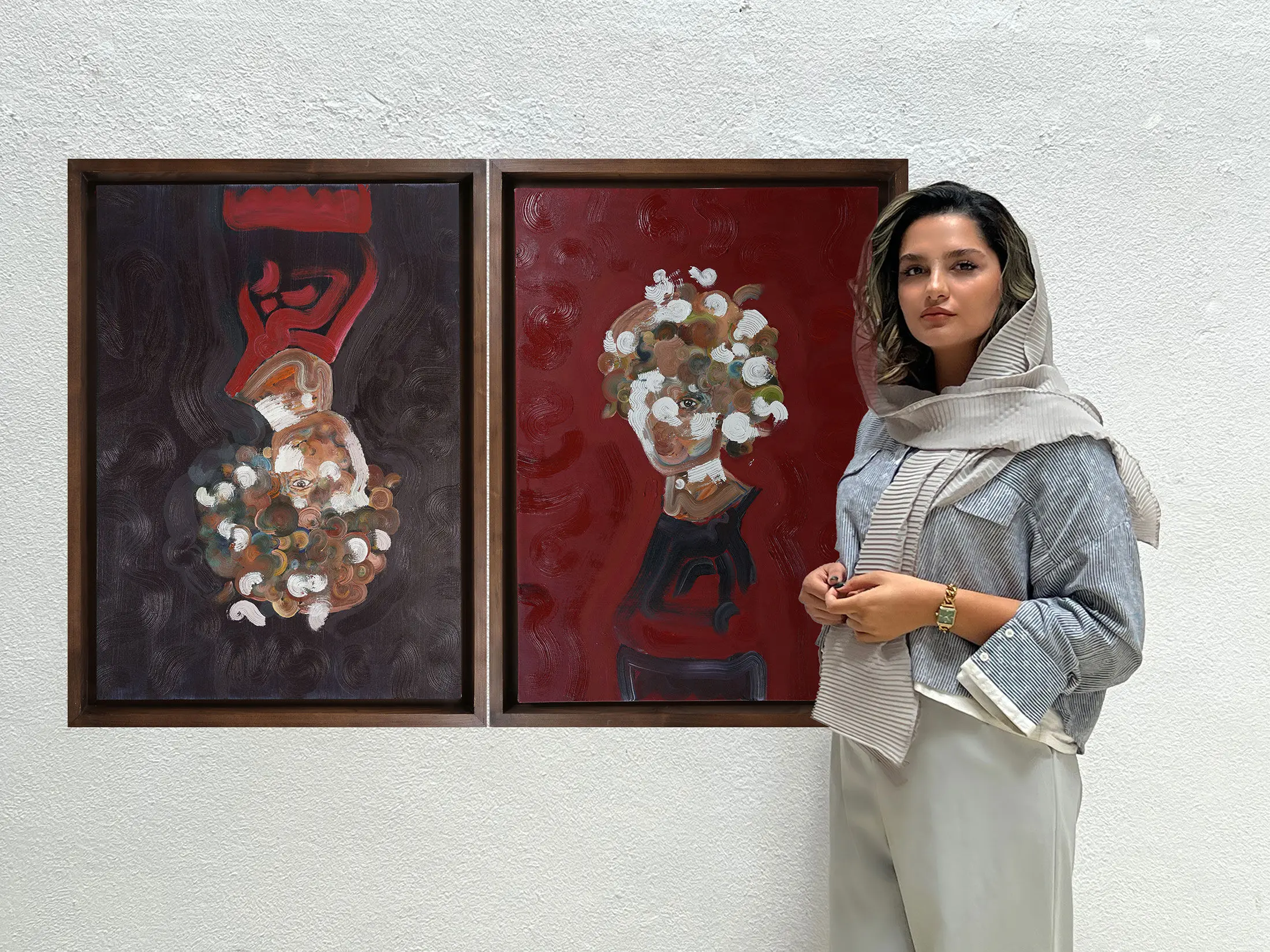
Rather than presenting a conventional portrait, Halo explores the human condition as a layered existence suspended between the physical body and the spiritual self.
Iran Art — We take a closer look at Halo, a striking oil-on-canvas painting by emerging Iranian artist Fardokht Kiaei Mehr, from her ongoing series Tekapo. Measuring 100 × 70 cm, the work commands attention from the very first glance through its compelling visual presence and emotional intensity.
Rather than presenting a conventional portrait, Halo explores the human condition as a layered existence suspended between the physical body and the spiritual self. The painting moves beyond representation, inviting viewers to engage with identity as something fluid, evolving, and deeply internal.
The face is no longer a site of certainty or recognition. Forms dissolve into one another, contours lose their stability, and colour abandons its descriptive function to become a language of emotion, perception, and lived experience. Repetitive, circular brushstrokes generate a sense of continuous motion, suggesting a state of turbulence between body and soul. The image appears suspended between emergence and dissolution, presence and absence, as though captured at a moment of perpetual transformation.
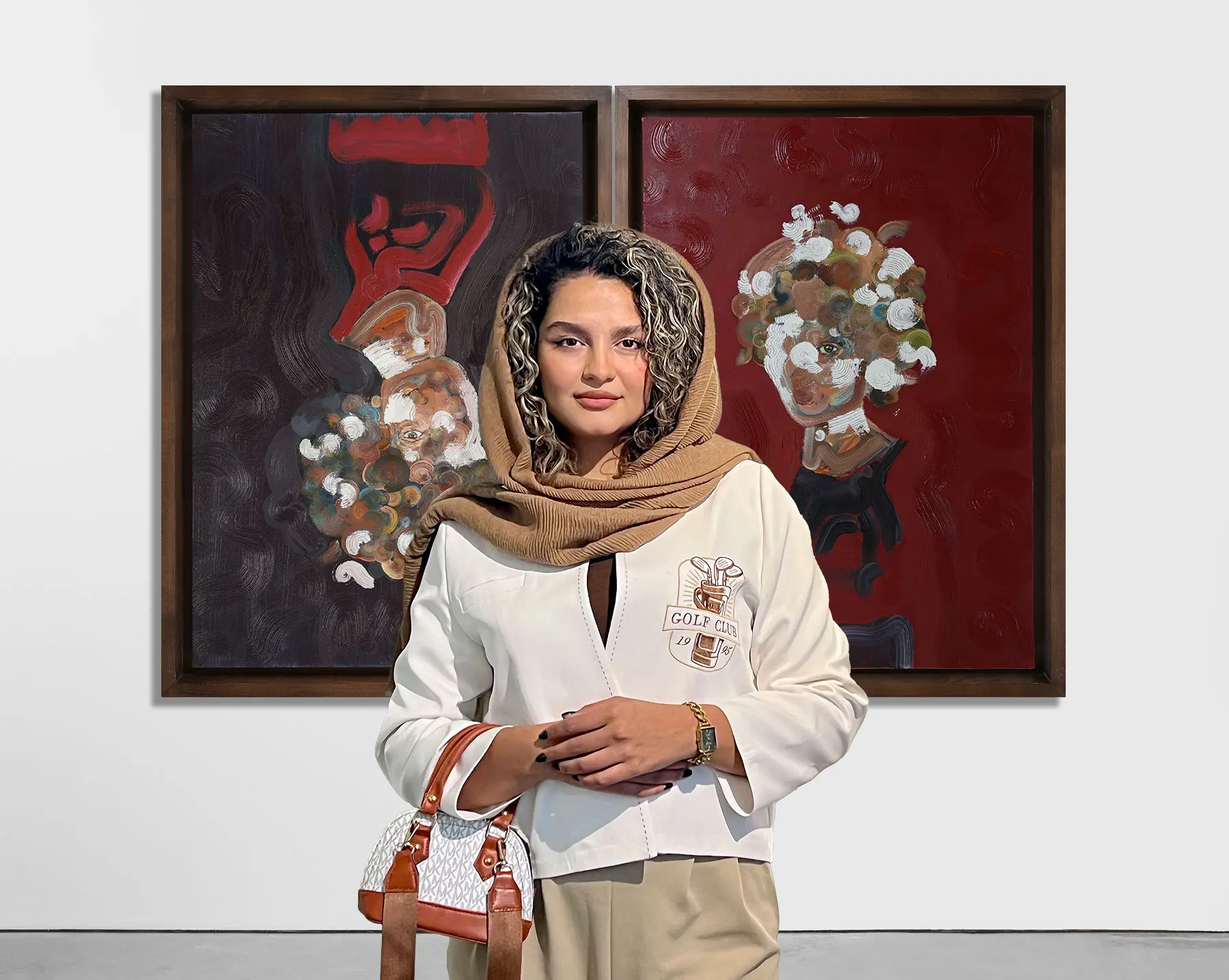
The diptych format is not merely a formal compositional choice but a fundamental component of the work’s conceptual framework. While each panel maintains its own visual identity, together they form a unified whole, evoking ideas of evolution, cyclical movement, and the coexistence of opposing forces. This relationship recalls the philosophy of Yin and Yang, where apparent opposites derive meaning through their interdependence rather than through absolute conflict. The inverted positioning of the two faces, together with the movement between upper and lower space, becomes a metaphor for the continuous exchange between inner and outer worlds, matter and meaning, body and spirit.
One of the painting’s most significant visual elements is the eye, the only facial feature that remains relatively stable and clearly defined. In a world where identity is constantly reshaped and reinterpreted, the eye emerges as a symbol of consciousness and perception. The emphasis on a single eye, while subtly implying the presence of the other, reflects the notion that although human beings possess two eyes, they experience the world through a singular, subjective perception—one inevitably shaped by personal perspective and limitation.
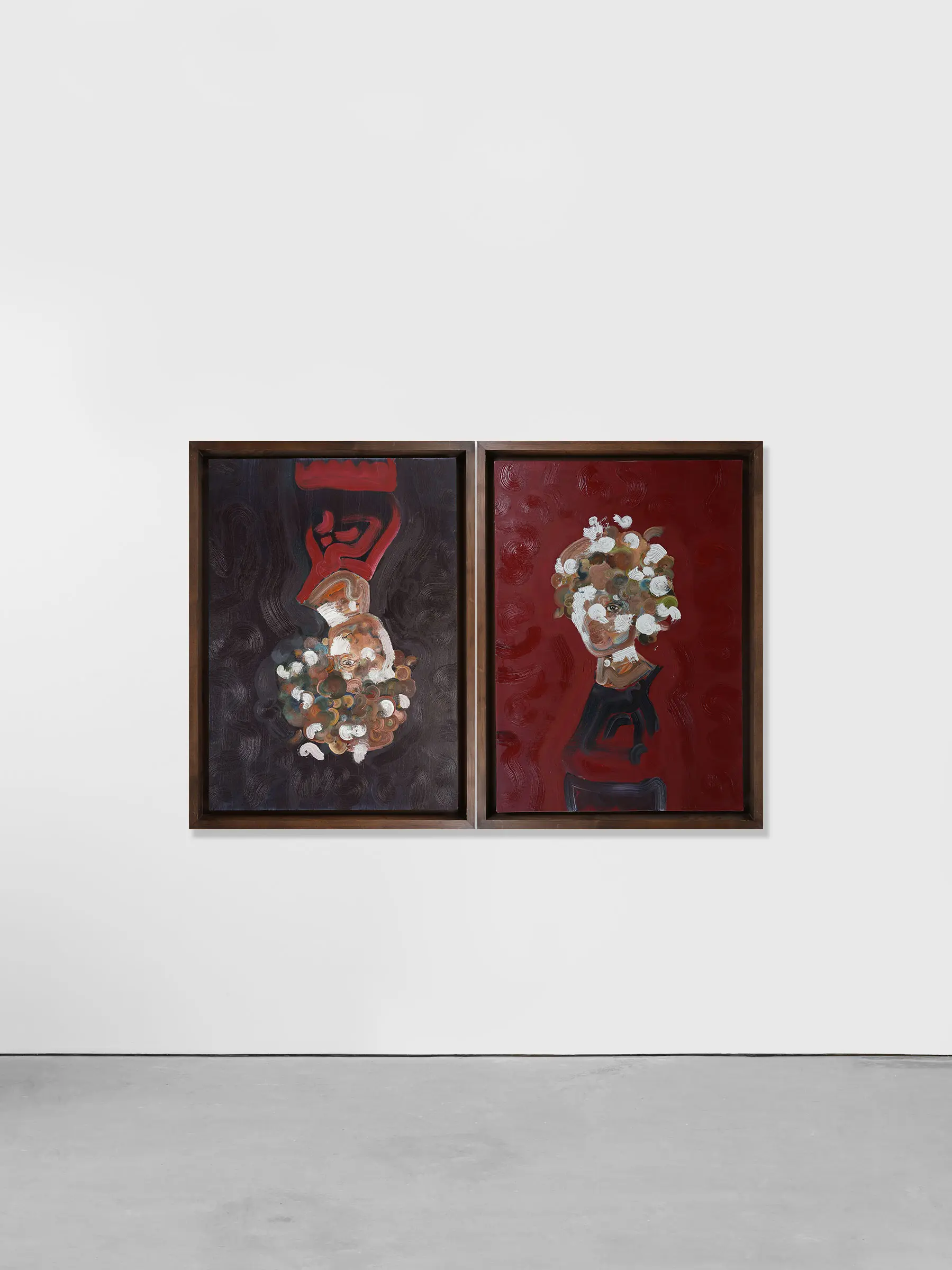
Equally significant are the deliberately unfinished areas of the face. These unresolved passages allude to the unseen dimensions of human existence—the spiritual aspect that can be sensed but can never be fully observed, articulated, or defined.
The dialogue between the dominant red and dark backgrounds carries symbolic meaning without prescribing a definitive interpretation. Rather than functioning as simple opposites, these colours coexist as simultaneous psychological and existential states. Their inversion across the two panels further suggests the mental and perceptual filters through which individuals construct their understanding of reality. What appears illuminated and self-evident to one observer may remain obscure or ambiguous to another. Although structurally interconnected, the two panels invite distinctly different visual and emotional experiences.
The richly textured surface and freely applied paint reinforce this conceptual approach. Rejecting polished perfection and visual certainty, the painting resists closure. Just as the human spirit cannot be confined within fixed definitions, the image itself refuses to settle into a final or absolute form.
Colour as the Primary Force of Attraction
The analysis of Halo begins with the observation that the work immediately captures the viewer’s attention. This immediate impact is achieved through the powerful interplay of saturated crimson, profound black, and textured passages of white.
By placing an intense red background in one panel and a deep black field in the other, Kiaei Mehr establishes a compelling visual duality between warmth and stillness, presence and absence, energy and contemplation.
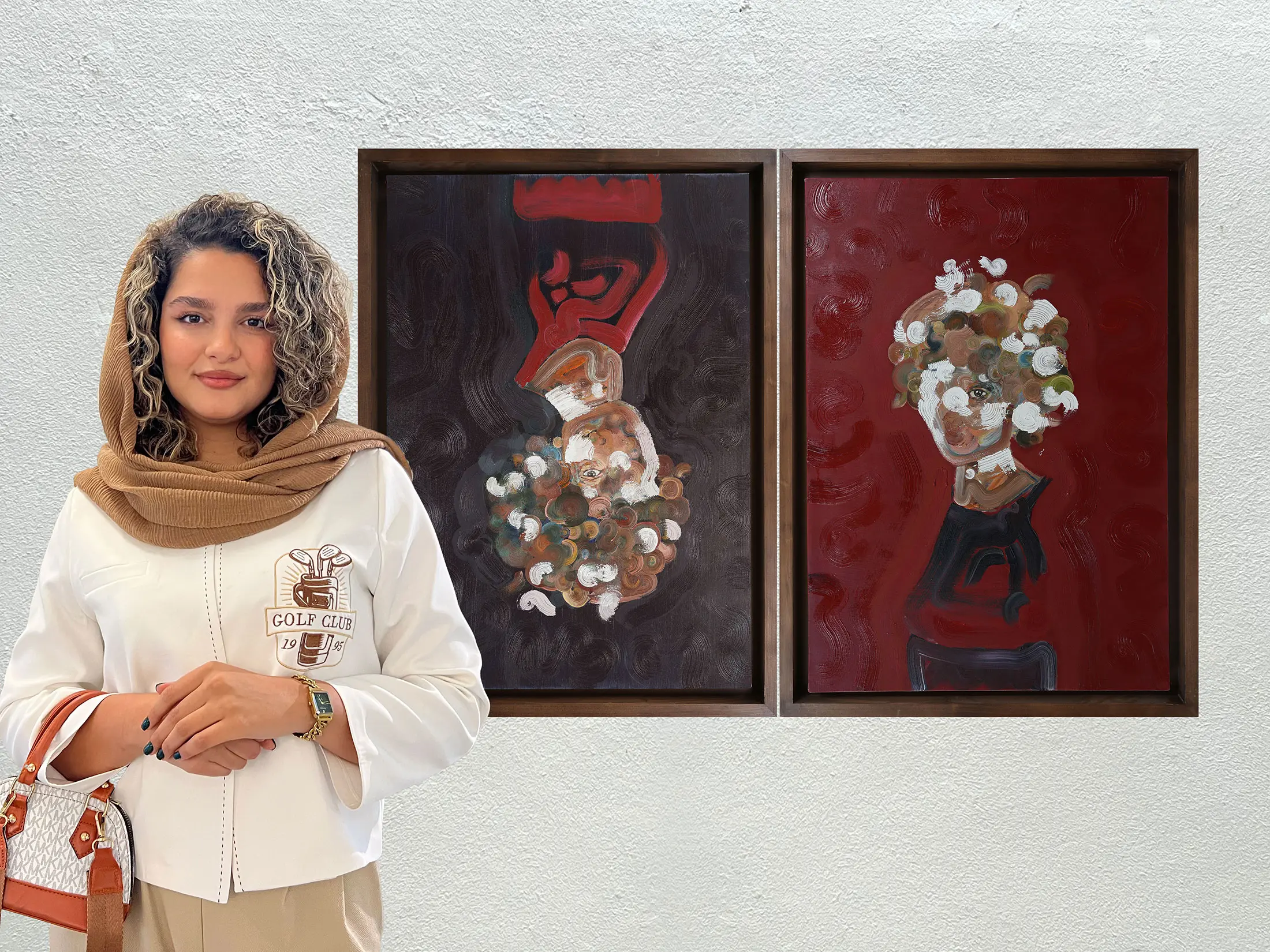
Across both panels, the faces and hair are constructed from circular applications of earthy tones, white, green, and ochre. Set against broad, uninterrupted backgrounds, these richly textured colour fields acquire remarkable vitality and dimensionality. This chromatic contrast naturally directs the viewer’s gaze toward the faces, reinforcing the painting’s central exploration of identity.
From a technical perspective, the work is built upon thick impasto and rhythmic circular brushwork. These repeated spiral gestures activate the canvas, replacing visual stillness with movement and tactile energy. Their recurrence throughout the faces, hair, and background establishes a formal unity that encourages the eye to travel continuously across the painting’s surface. Amid this dynamic rhythm, a single meticulously rendered eye functions as the compositional focal point, concentrating the painting’s visual energy while reinforcing its meditation on perception, consciousness, and the elusive nature of human identity.