

Fatemeh Ahmadian and Woman: Narratives of Female Tragedy Draped in Beauty
With remarkable skill, the young painter Fatemeh Ahmadian brings traditional miniature painting to the threshold of contemporaneity, articulating contemporary concerns through a classical visual language. She also speaks of pain and tragedy within a richly colored, beautiful visual world. Ahmadian knows how to portray catastrophe in such an aesthetically captivating and vibrantly colored manner that collectors feel no reluctance to hang the painting on the wall before them. These three qualities have helped her paintings find their way into art collections in Iran and around the world.
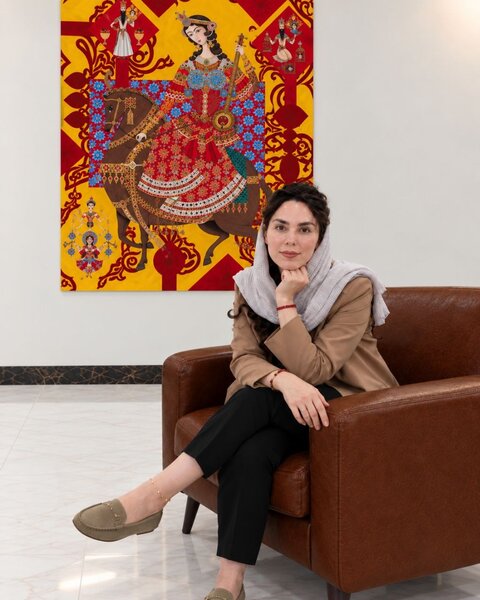
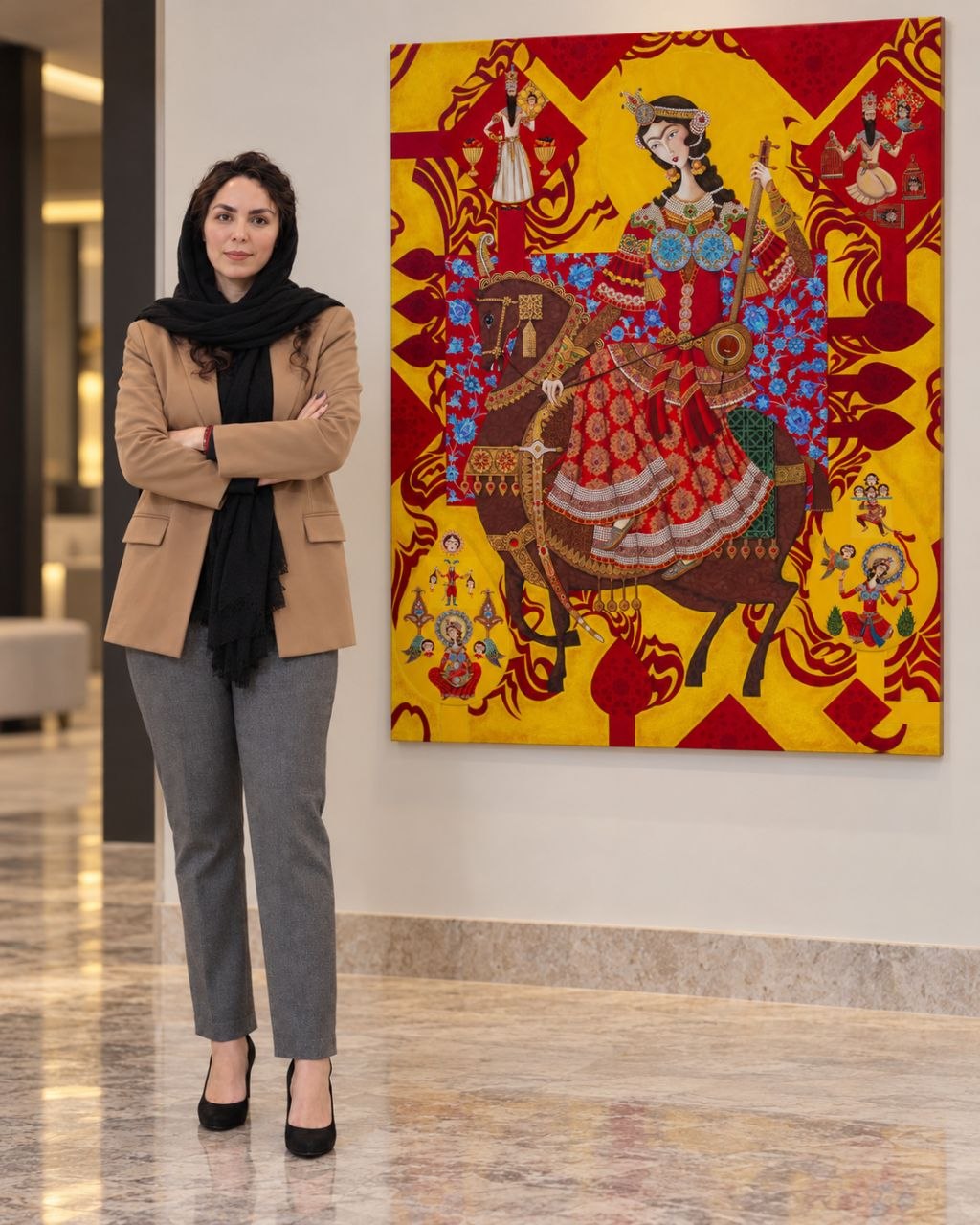
IranArt : We examine a painting by Fatemeh Ahmadian titled Woman, created in 2019 using oil on canvas, measuring 120 × 150 cm. The work was acquired by Jason Carey, a Jamaican art collector based in Dubai, and is now held in his private art collection.
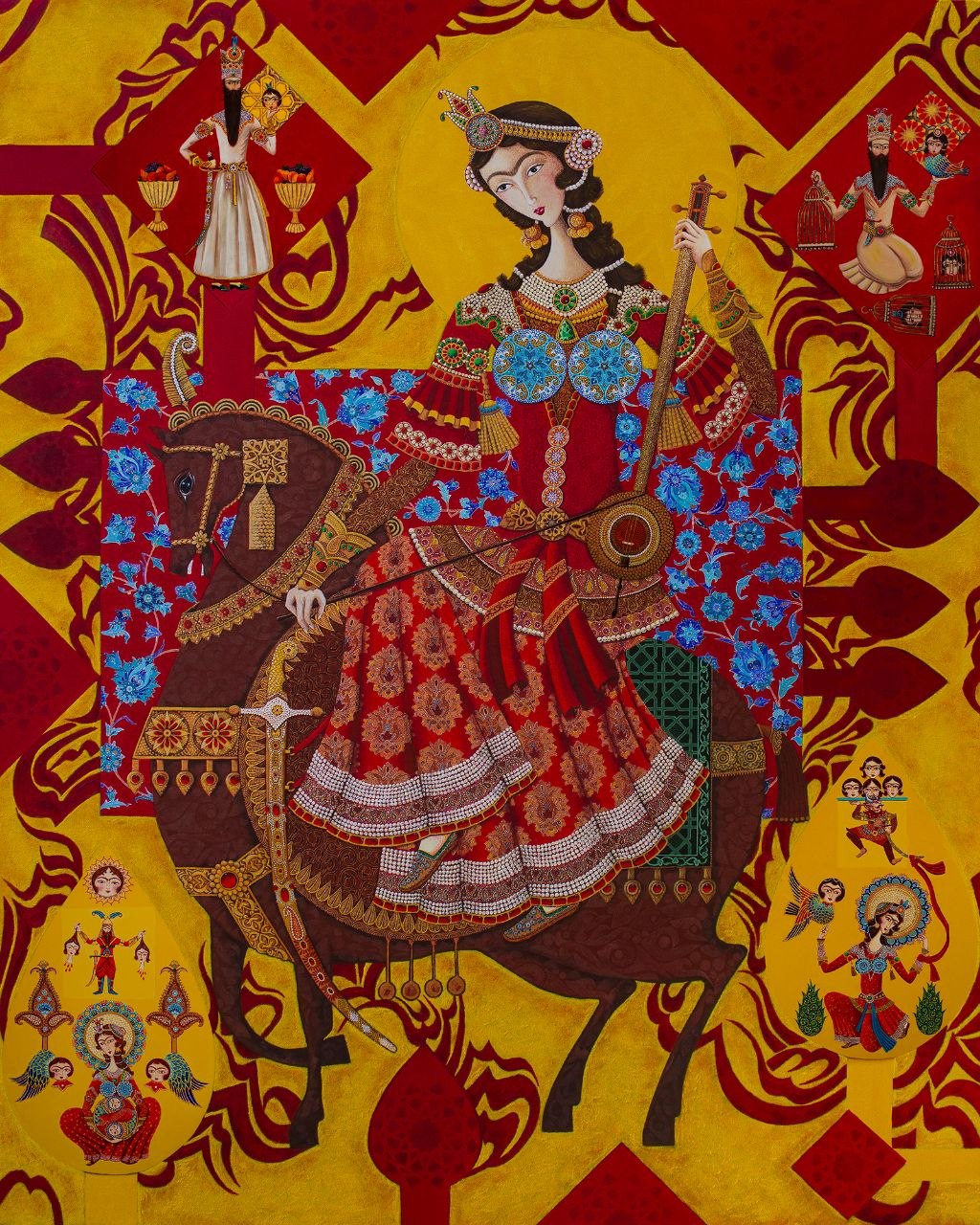
_Aesthetic Analysis of Fatemeh Ahmadian’s Woman
Fatemeh Ahmadian’s Woman is a painting in which decorative structure, multilayered storytelling, and the reinvention of traditional visual language converge to create a complex field of meaning.
With remarkable skill, the young painter brings traditional miniature painting to the threshold of contemporaneity, articulating contemporary concerns through a classical visual language. She also speaks of pain and tragedy within a richly colored, beautiful visual world.
Fatemeh Ahmadian knows how to portray catastrophe in such an aesthetically captivating and vibrantly colored manner that collectors feel no reluctance to hang the painting on the wall before them. These qualities have helped her paintings find their way into art collections in Iran and around the world.
The composition of Woman is organized around a central figure: a woman riding a horse. Her larger scale and commanding position establish her as the primary focal point. Yet the significance of this figure extends beyond her central placement. The curved contours of the horse’s body, the expansive sweep of the woman’s skirt, the diagonal extension of the musical instrument, and the repetition of textile patterns create a network of visual movements that guides the viewer’s gaze across the canvas. Despite the density of its elements, the painting maintains an internal coherence, with its components deriving meaning from their relationships to one another.
Color in Fatemeh Ahmadian’s painting serves a purpose beyond visual attraction. The luminous yellow background, the deep reds of the garments and surrounding motifs, and the scattered blues across the textiles form the three principal poles of the painting’s chromatic structure. Their interplay lends the image energy and visual prominence without relying on naturalistic chiaroscuro. The intensity of yellow and red transforms the painted surface into a resonant visual field, while turquoise blues and restrained greens introduce pauses within this intensity, helping to establish a relative balance. Crucially, color is not used merely to represent objects; it becomes an independent vehicle of meaning. This relative autonomy from naturalistic representation brings the work closer to traditions in which the decorative value and emotional force of color take precedence over the precise depiction of the external world.
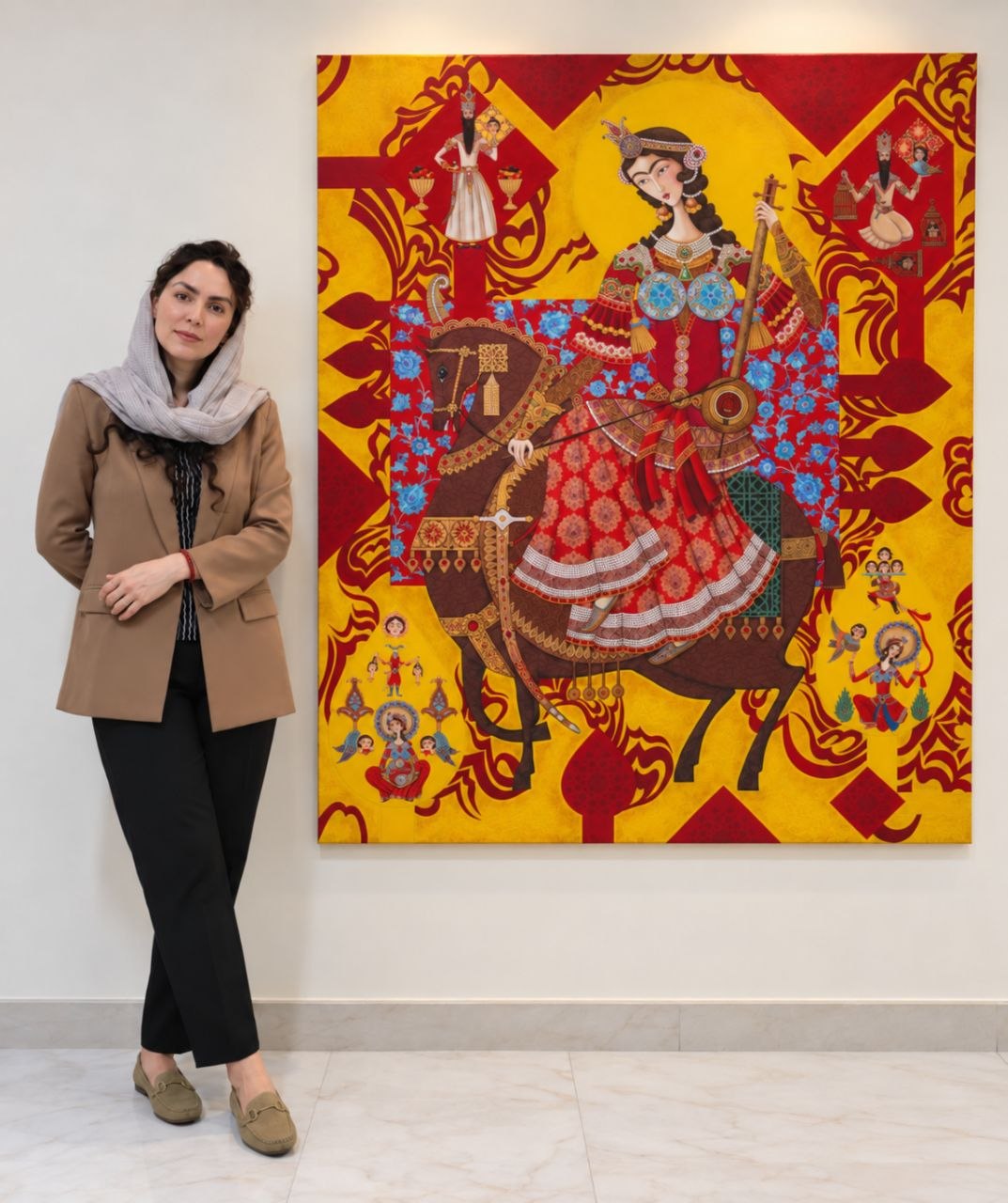
Formally, the painting is built on the juxtaposition of flat areas and densely rendered details. The woman, horse, garments, and peripheral elements are distinguished by clearly defined contours. Yet these divisions do not fragment the image, as recurring botanical, geometric, and curved motifs establish connections between its different sections.
The exquisite refinement of Fatemeh Ahmadian’s painterly practice is particularly evident in the woman’s clothing. Intricate ornamentation and multiple layers of motifs create a richly textured, almost jewel-like surface, revealing both the artist’s technical mastery and her ability to generate interpretation, meaning, and contemporary relevance through decorative form.
At the same time, the relatively open expanses of the yellow background provide visual breathing space. The interplay between density and relative emptiness prevents the composition from becoming monotonous.
The difference in scale between the central figure and the smaller narrative scenes surrounding her creates a hierarchy of meaning rather than conventional perspectival depth. The painting appears less like a window onto the real world than a surface on which multiple dimensions of human experience converge.
One of the most notable features of Woman is its relationship to Persian miniature painting and Iranian narrative traditions. The placement of multiple scenes within a single pictorial plane, the relative disregard for naturalistic proportions, and the meticulous treatment of clothing and ornament recall approaches in which storytelling is not confined to a single moment.
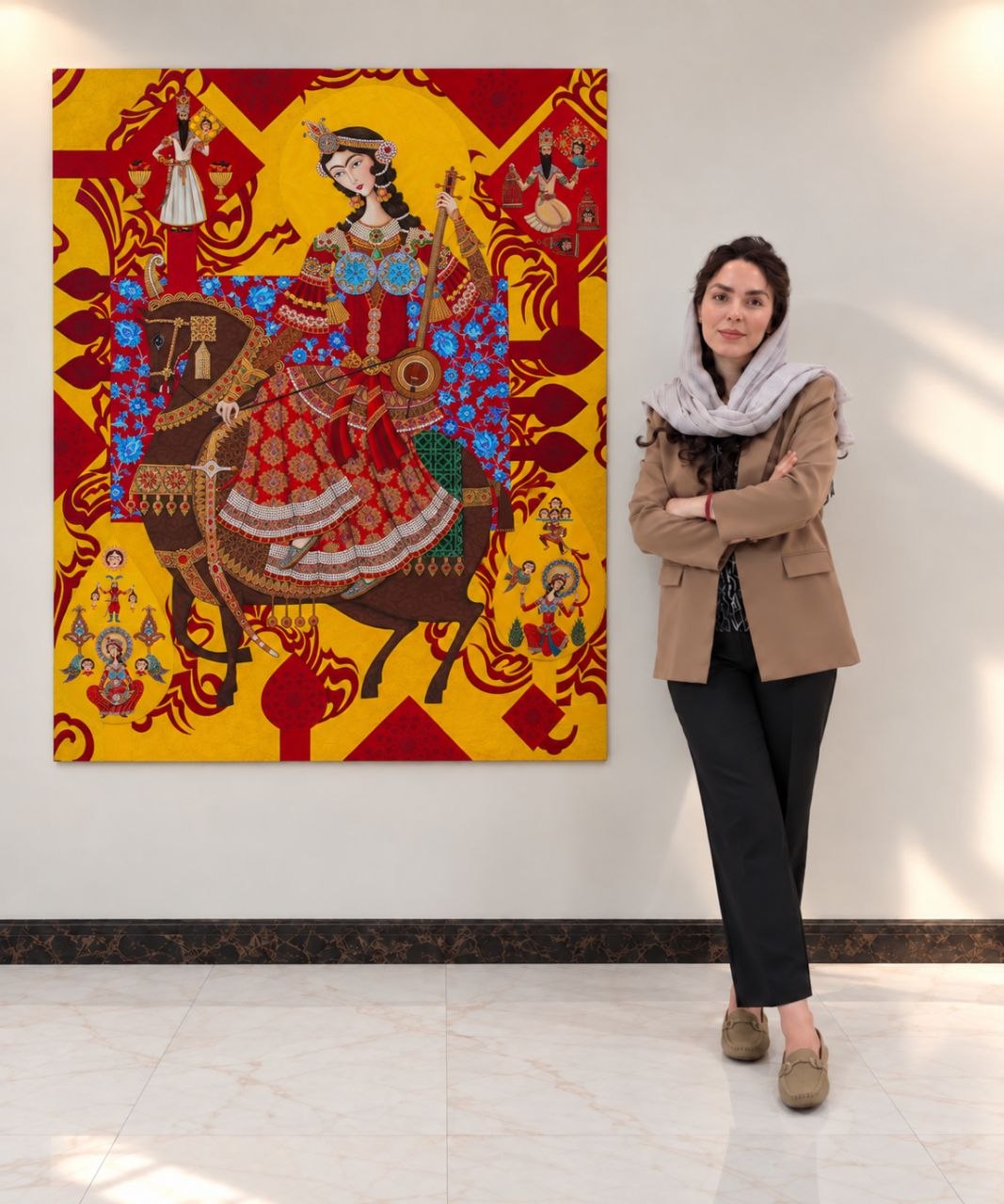
Nevertheless, the work cannot be regarded as a mere reproduction of a historical model. By positioning the central figure alongside smaller characters and episodes, Ahmadian constructs a visual system in which secondary elements do more than provide decorative embellishment; they actively participate in the overall interpretation of the image. This structure invites the viewer to engage in a nonlinear act of looking. The gaze is initially drawn to the center, moves toward the surrounding details, and then returns to the central figure with a renewed understanding of the relationships between the painting’s various elements.
From the perspective of visual psychology, the apparent composure of the woman’s face creates a meaningful distance from the potential turmoil suggested by the surrounding narratives. Ahmadian has rendered the face with soft contours, elongated eyes, and a controlled expression. Against the intensity of the colors and the abundance of detail, this restraint establishes a sense of inner stillness. Contrary to an initial impression, however, this stillness does not necessarily imply passivity. Instead, it lends the central figure a contemplative quality.
Despite its physical power and substantial presence, the horse remains integrated into the painting’s overall structure, functioning as a visual link between the woman and the ground beneath her.
The musical instrument in the woman’s hand introduces a diagonal line that disrupts the equilibrium of horizontal and curved forms while creating an additional pathway for the viewer’s gaze. Beyond its compositional function, the instrument also opens another interpretive dimension, suggesting associations with feminine identity and giving the work an additional layer of meaning.
The aesthetic value of Woman lies in its ability to bring decorative language, multivalent storytelling, and emotional expression together within a unified structure. The painting neither seeks simplicity by eliminating detail nor sacrifices coherence through an excessive accumulation of ornament. Instead, it establishes a balance between these two tendencies, producing an image that is intricate, visually captivating, and thought-provoking.
Viewers may initially take pleasure in the harmony of the colors, the delicacy of the patterns, and the sophistication of the ornamentation. Yet this pleasure does not remain at the level of visual appreciation alone. The closer one looks, the more apparent the relationship becomes between the beauty of the surface and the complexity of the meanings beneath it. Here, beauty becomes a means of organizing visual experience and guiding the viewer from observation toward reflection.
_ Fatemeh Ahmadian’s Statement on Woman
Fatemeh Ahmadian, the artist behind Woman, explains:
“In this work, I have not depicted war directly through a battlefield or military scenes. What mattered to me was the role and suffering of women in the context of war: a woman who can possess power while also being among the first victims of escalating violence and instability.
“At the center of the painting, I have depicted a woman riding a horse. She is calm, dignified, elegant, and powerful at the same time. She holds a musical instrument, and it was important to me that, at first glance, her femininity, dignity, and beauty should be visible. But when viewers spend more time with the image, they begin to recognize the power behind this elegance. For me, female power does not necessarily mean abandoning femininity. A woman can be both delicate and elegant, yet also authoritative.”
Fatemeh Ahmadian continues:
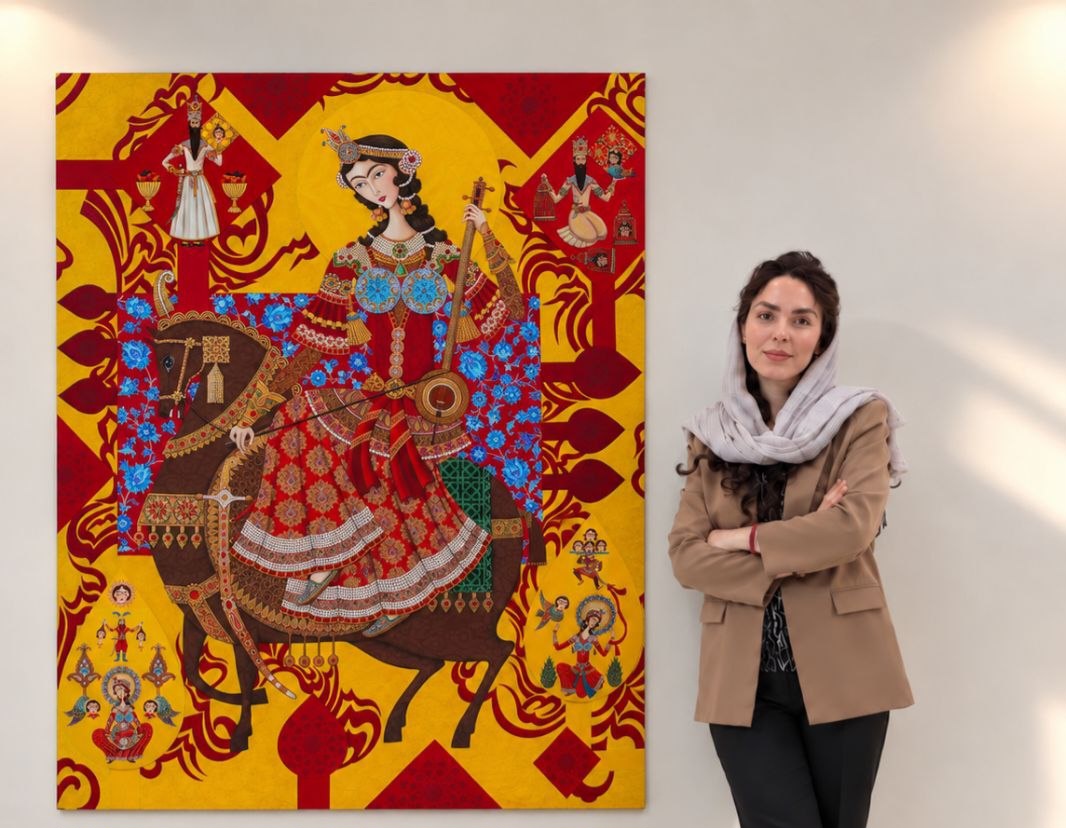
“I have placed several smaller narratives throughout the painting, each representing an aspect of women’s experiences within structures of power and war.
“In the upper-right section, a king is shown keeping women in cages and replacing them one after another. For me, this represents a time when women become playthings of power, reduced to interchangeable beings.
“In another section, I have placed a woman beside vessels of fruit. This, too, refers to the objectification of women: the moment when a woman is no longer seen as a human being but is reduced to something to be looked at, consumed, or possessed.
“In the lower-right section, I have depicted a woman whose hands are bound and who is held captive by a demonic creature. This image refers to the violence, captivity, and loss of agency that women experience in wartime. For me, war is not simply a military conflict; it is a condition that intensifies many forms of violence that already exist.
“On the other side, I have depicted a pregnant woman with two fetuses. This section concerns the suffering of motherhood: a mother who endures the hardships of pregnancy and childbirth, only to risk losing her children in war. The two severed heads depicted above continue this narrative. I have always wondered: In narratives of war, who sees a mother’s suffering? Who acknowledges the loss that remains with a woman after her child dies?”
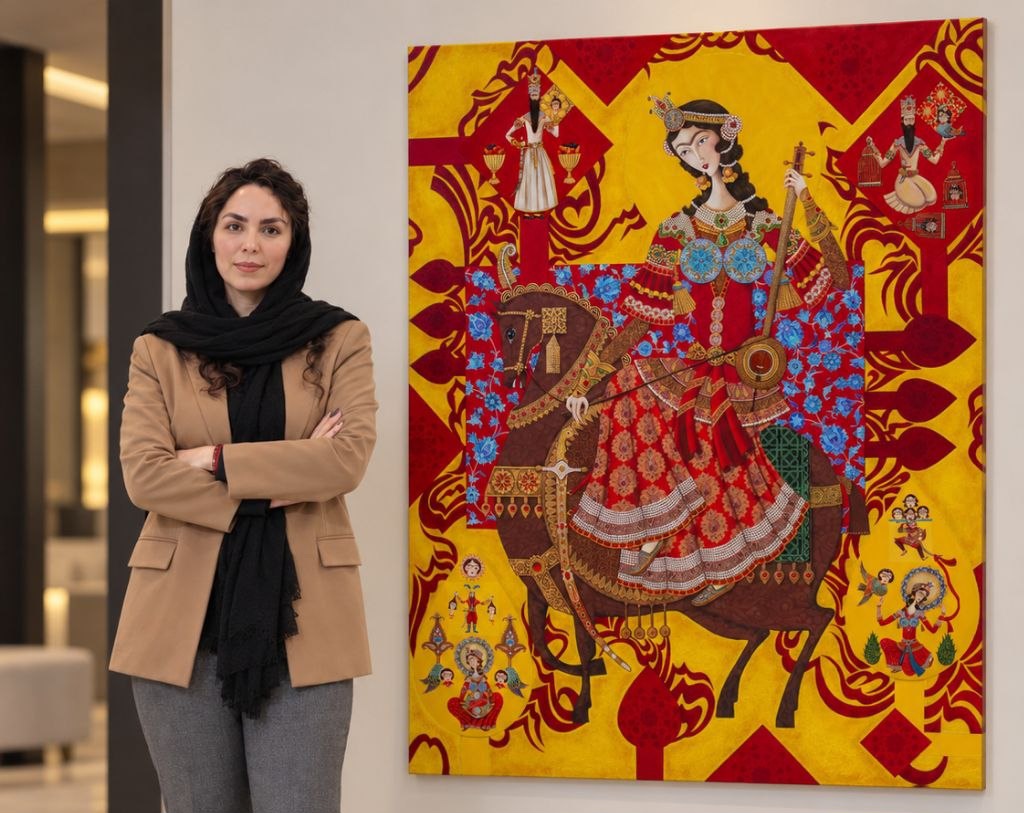
The young painter further explains: “Despite all this bitterness, I did not want the work to appear visually dark or brutal. On the contrary, I used joyful colors, ornamentation, dynamic rhythms, and a visually captivating atmosphere. This contrast matters to me. I like to speak about painful subjects through the language of beauty.
“This painting can exist within a living space, where viewers can take pleasure in looking at it. Yet the subject unfolding within it is bitter and serious. For me, beauty is not meant to deny suffering; it is meant to bring the viewer closer to it.”
Fatemeh Ahmadian emphasizes that the subject of the painting is not confined to a particular historical period:
“For me, the subject of this work belongs to no specific time. War, captivity, violence, the objectification of women, and the suffering of motherhood are not limited to one period or one geographical location. These are issues that have recurred throughout history and continue to recur today.
“If I were to summarize the entire work in a single sentence, I would say: ‘For me, the bitterness of the subject in this painting has not been removed; it has simply been dressed in beauty.’”
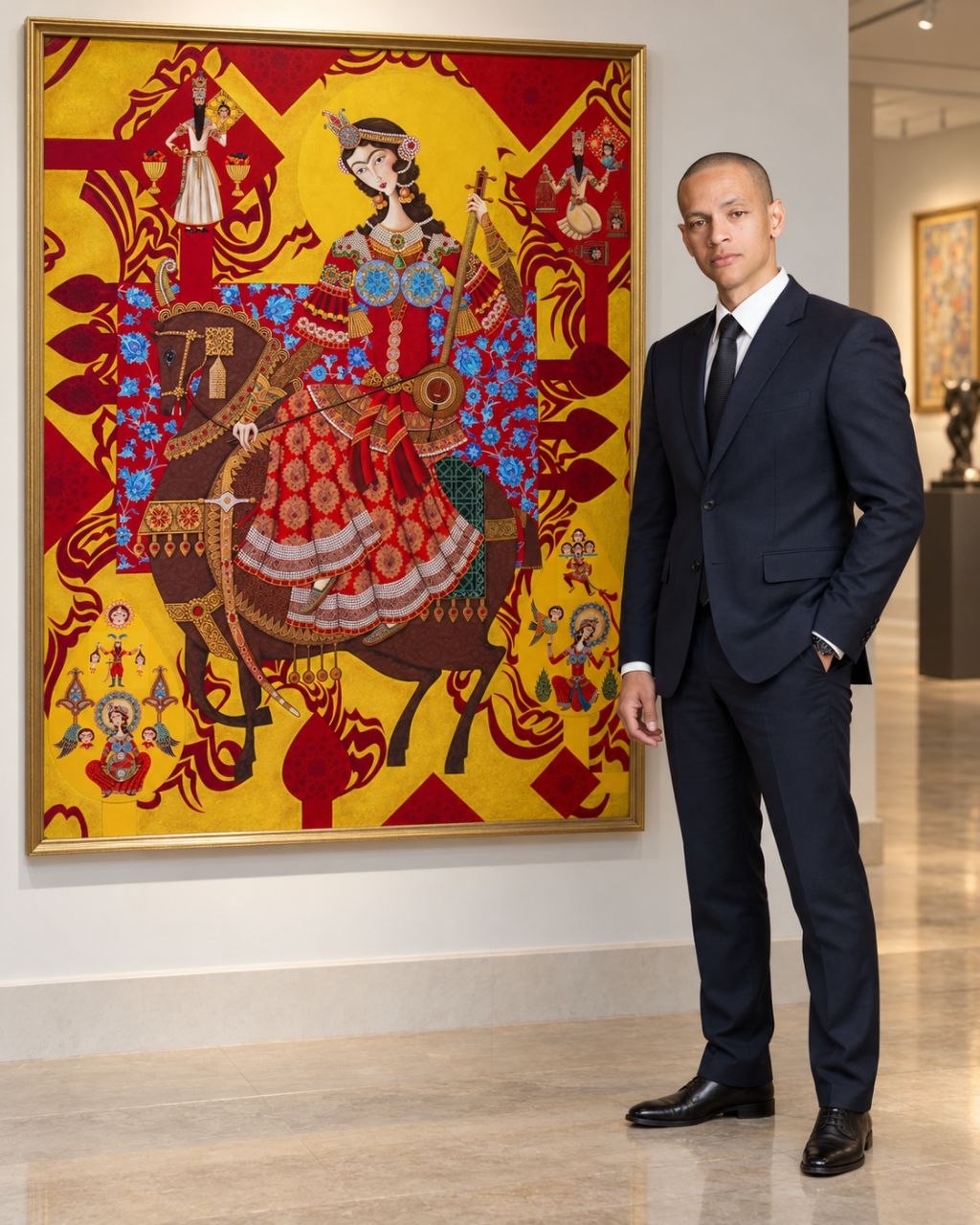
The striking and thought-provoking painting Woman was acquired by Jason Carey, a Jamaican art collector based in Dubai, and is now part of his art collection.
_ Fatemeh Ahmadian’s Art Market and Collectors
Fatemeh Ahmadian, born in 1982 in Khansar, Iran, holds a bachelor’s degree in Islamic Arts, specializing in ceramics and sculpture, from Isfahan University of Art.
In 2021, her painting Prophet Jonah (Younes Nabi), measuring 160 × 200 cm, was acquired in a private sale for $4,500 by a collector based in Dubai.
Another major work, The Fourth Trial of Rostam: Rostam’s Battle with the Sorceress, was created in 2021 using oil on canvas and measures 160 × 200 cm. The painting was acquired by Shahdad Fazeli and is now housed in the Fazel Library in Khansar, Isfahan Province.
Fatemeh Ahmadian’s work has attracted attention within the art community and the art market because of its distinctive worldview and recurring thematic concerns. At first glance, her paintings may appear classical and traditional; after a few minutes of sustained looking, however, their contemporary dimensions begin to emerge. This interplay between historical visual language and contemporary meaning, combined with the strength of her draftsmanship, has contributed to the growing interest in her work.