

Fardokht Kiaeimehr and the “Lapoushooni” Collection: The Aesthetics of Color Minimalism
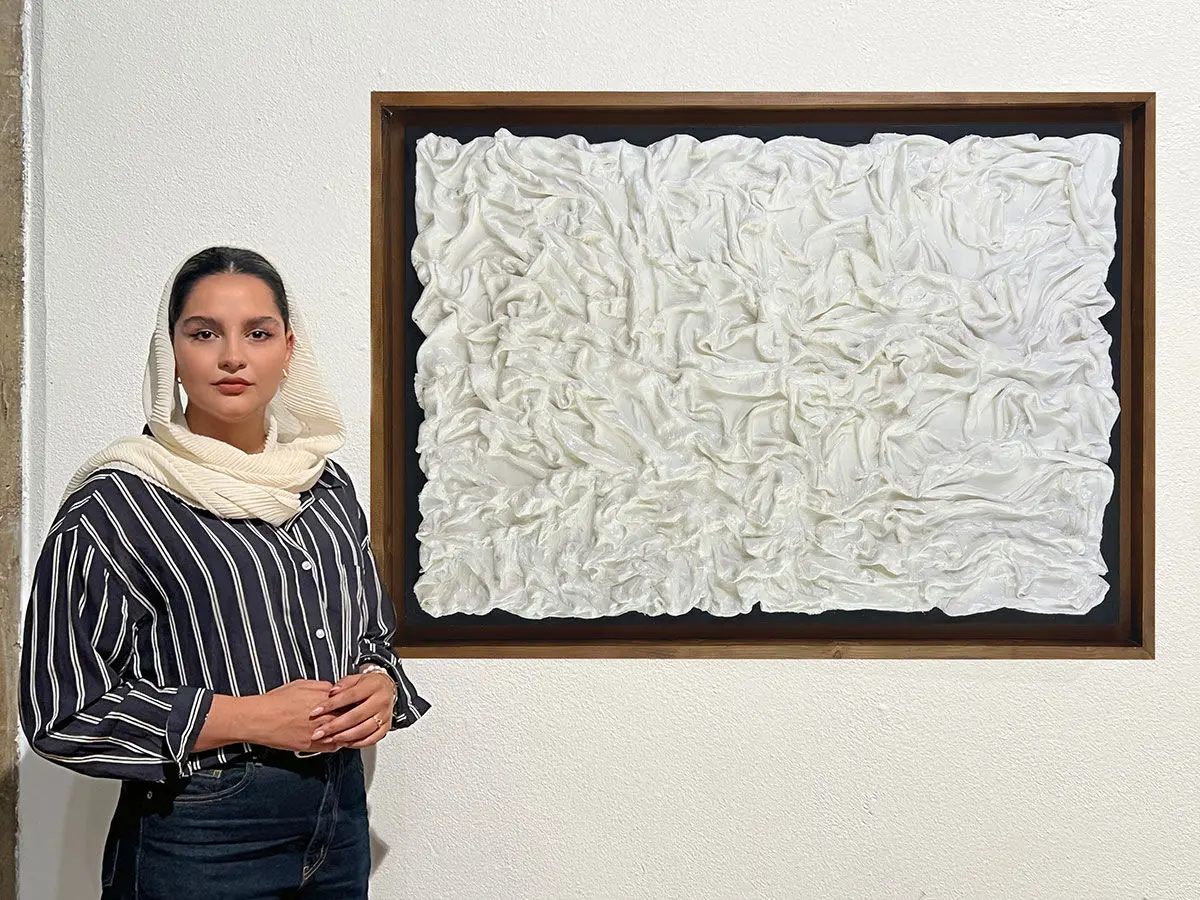
The use of chromatic minimalism alongside textural maximalism creates a striking interplay of contrasts. The work possesses a powerful sensory presence; viewers instinctively feel compelled to touch its surface. This tactile quality plays a central role in the aesthetic language of the piece.
Iran Art reviews a mixed-media work by Fardokht Kiaei Mehr from her Lapoushooni series, created on a 100 × 70 cm canvas. Positioned at the intersection of painting, sculpture, and installation, the work challenges the traditional boundaries of two-dimensional painting.
In the artist statement accompanying the series, Fardokht Kiaei Mehr writes: “In this collection, I attempted to create textures on the canvas and perspectives formed through light across the surface, providing space for individual interpretations. Each person can discover a different image and develop a personal reading within these textures.”
The artwork presents a complex yet fluid surface: white folds that continuously shift through the interplay of light and shadow, inviting viewers into an ongoing process of discovery and reinterpretation. Lapoushooni — meaning concealment or veiling — functions not only as the title of the series but also as its conceptual framework. Through texture and volume, the work simultaneously reveals and obscures layers of presence and absence.
While remaining deeply rooted in materiality and form, the piece also opens a space for the viewer’s imagination. Each gaze effectively completes part of the work, making the interaction between audience and canvas fundamental to the essence of the series.
The most prominent feature of Kiaei Mehr’s work is its raised, three-dimensional texture. The folds and intertwined surfaces evoke associations with fabric or frozen waves, conveying movement and stillness at the same time.
The monochromatic use of white directs attention toward volume, light, and shadow rather than color variation. White also evokes notions of purity, timelessness, and placelessness.
As the textured surface interacts with light, shifting perspectives emerge; every viewing angle offers a new visual experience.
The dark wooden frame creates a subtle contrast with the luminous white surface, guiding the viewer’s focus inward. The absence of a fixed center or strict geometric order allows the eye to move freely across the composition.
In her statement, the artist emphasizes her intention to create a platform for diverse personal interpretations. This openness to subjective reading places the work firmly within the discourse of contemporary and phenomenological art.
The wrinkled textures may be interpreted as metaphors for memory, wounds, or traces of time, while also remaining open to the personal associations of each viewer.
The whiteness of the work further suggests emptiness and possibility — a blank field onto which viewers may project their own mental imagery and narratives.
By combining chromatic minimalism with textural maximalism, the artist creates a compelling dialogue between opposing visual languages.
The sensory dimension of the work is particularly strong; viewers unconsciously experience a desire to touch the surface. This tactile quality occupies a significant place in the overall aesthetic experience of the piece.
The work remains deliberately open-ended, allowing each viewer to perceive something different within it — fabric, mountains, waves, skin, or even an internal psychological landscape. This participatory quality gives the work a distinctive relevance within contemporary art practices.
Ultimately, this work by Fardokht Kiaei Mehr merges minimal color with maximal texture, using the absence of color to foreground form, light, and interpretation. More than a fixed image, the piece functions as a space for individual perception — where material and light enter into an open dialogue with the viewer’s imagination.
Fardokht Kiaei Mehr, born in 2000, earned her BA in Painting from Soore University and has been professionally active in the arts for seven years.
Her broader practice also includes hand-pulled prints created through line-art techniques, as well as collections developed using metal pen and watercolor.